
Health & Wellness Blog
Tinnitus Special Edition
February 20, 2026
Health & Wellness Blog
Tinnitus Special Edition
February 20, 2026
New insights from Harvard Health and Mayo Clinic reveal subtle shifts in the cochlear membrane — helping those with tinnitus move toward recovery and natural daily relief.

Buzzing. Whooshing. Ringing. A subtle sense of inner pressure.
While sound amplification has long been the standard, emerging research now highlights gentle, natural ways to support auditory balance at home — adding a thoughtful layer of support for focus, emotional steadiness, and daily clarity.

Many describe something harder to explain than sound. Buzzing. Whooshing. A subtle internal pressure. Over time, it becomes less about volume — and more about effort.
What lingers is a quiet mental tension: difficulty settling the mind, sleep that doesn’t fully restore, a sense of never fully powering down. Because when auditory signals arrive distorted, the brain compensates — predicting and filling gaps. A subtle process. A cumulative cost.
The brain continues compensating even during sleep.
Background processing quietly drains cognitive energy.
Over time, deep mental quiet becomes harder to access.
Which is why masking buzzing in the ears may soften perception while the deeper neuro-regulatory strain continues beneath the surface.
Which may explain why some report improved mental clarity before any noticeable change in sound — suggesting tinnitus often reflects signal distortion, not true silence.
Neural circuits reorganize around persistent sound. The brain adapts — but adaptation is not resolution.
This may explain why tinnitus feels permanent and why mental quiet becomes harder to access over time.
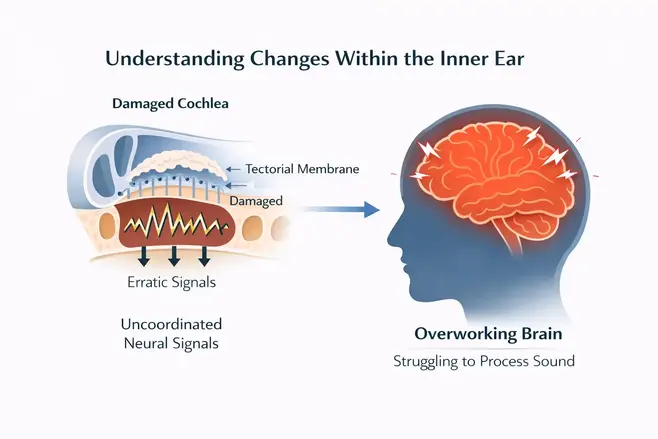
Rather than focusing only on the auditory nerve, current research is examining how sound is mechanically translated inside the cochlea.
One structure drawing attention is the tectorial membrane — a microscopic, flexible layer essential for converting vibration into clean, coordinated neural signals. When its mechanical properties shift, even subtly, signal precision can degrade. The brain responds the only way it knows how: by working harder.
Researchers affiliated with these institutions have noted that tinnitus can persist even when the auditory nerve appears intact. As one review summarized: “If the issue were purely peripheral, the sound should diminish. In many cases, it does not.”
The brain’s auditory pathways possess a remarkable capacity for lasting restoration. Modern research confirms that neural environments are highly responsive to targeted, stabilizing support. By prioritizing neuro-regulatory clarity, it is possible to quiet persistent tension and guide the system back to its natural, restorative baseline.

People who "get used to" tinnitus often report fatigue, reduced mental sharpness, and emotional strain — even when hearing tests appear normal.
Explore the Research →
Sometimes, relief begins with being heard. On our blog, we explore how personalized sessions uncover subtle patterns behind persistent internal sound, helping those with tinnitus move toward natural daily relief.
Start Understanding Your Tinnitus →If tinnitus were just an ear issue, masking sound would be enough. But when the problem is neural overload, relief starts somewhere else with restoring regulation before cognitive strain accumulates further. This is the foundation behind neural regulation support designed for daily environments.
Understand how the neuro-regulatory method may support cognitive recovery at home → Free Presentation • A Simple, At-Home MethodFor educational purposes. Illustrations and descriptions are simplified to aid understanding.
Timely neural support may reduce chronic auditory stress and promote cognitive equilibrium.

Research increasingly suggests tinnitus persistence involves broader auditory network regulation mechanisms.
When neural signaling stabilizes, the brain may reduce unnecessary hyper-alert processing patterns. Proactive guidance supports clarity, confidence, and sustainable cognitive balance over time.
Neural Insight: Addressing regulation early may help protect both silence and long-term mental vitality.
Your brain doesn't suddenly stop adapting. It becomes overloaded. Auditory strain builds quietly. Regulation weakens over time. Understanding where you are isn't about a quick fix. It's about supporting your brain while its natural adaptability is still active.
See how daily neuro-regulatory can support mental clarity at home → Free Presentation • Visual & Research-InformedDisclaimer:
Experiences shared reflect individual perspectives and are not intended as medical claims.

Florida
Commercial Real Estate Consultant
📧 Email testimonial • Submitted March 2025
"I didn’t realize how much energy the noise consumed. Gaining a clear perspective on the science brought immediate lightness. Understanding the sound was key to regaining my focus."

Colorado
Retired School Administrator
💬 Support group post • Submitted April 2025
"The tension of the unknown was exhausting. Learning how the brain settles changed my entire outlook. I'm no longer fighting the sound; I finally understand it."

Connecticut
Former Mechanical Engineer
📝 Written testimonial • Submitted June 2025
"I assumed this strain was just aging. Discovering the mechanics of auditory health changed everything. Understanding how the brain navigates noise stopped it from running my life."
Your brain still adapts.
Even after years of strain.
What matters is giving it the right signal at the right time.
See how the neuro-regulatory method works in practice → Research-Informed • Visual • No Invasive ProceduresNo. This is not a medical treatment or a cure. This is an educational explanation of how prolonged auditory strain affects the brain and how high-demand environments address neural stability. It introduces a brain-based regulation framework, not a medical intervention.
No. There is no medication, device, or external equipment involved.
The approach centers on guided neural regulation designed to help the brain exit constant alert mode, rather than relying on tools or masking strategies.
This content introduces a structured neural stabilization , informed by aviation and performance research, that explains how the brain can relearn stable sound processing after prolonged strain.
Full details and supporting explanations are presented clearly in the complete presentation.
Most approaches focus on the ear or on managing sound itself. This perspective focuses on how the brain responds to ongoing auditory strain, and how restoring regulation may change that response over time.
The material introduces non-invasive, at-home neural support concepts drawn from research used in high-demand environments. It is presented for understanding and awareness, allowing individuals to learn how neural regulation is approached outside of clinical settings. Considerations around personal health and next steps are addressed in the full explanation.